


Guided by ambition and passion to create quality fashion for all, we are determined to continue to innovate and raise our efficiency while reducing our impacts. We are advancing towards a circular model and to achieving net zero emissions.



We are determined to reduce our impact by acting on our water, energy and natural resource consumption. We want to contribute to the battle against climate change and loss of biodiversity through alignment with the United Nations’ recommendations and aspirations, so helping to protect the planet and its inhabitants. At Inditex we are agents of change. The company was one of the first signatories of the United Nations Global Compact back in 2001, since when we have consistently demonstrated our firm commitment to people and the environment. Together with renowned scientists, social and environmental organisations and partners from a range fields, we want step up and contribute to innovation in the world of fashion and spearhead the transformation of our industry. To that end we have set targets to help us visualise where we are headed and the challenges we need to overcome along the way. With those targets we aim to stimulate innovation and attract the talent and resources needed to bring about change that affects our entire industry.

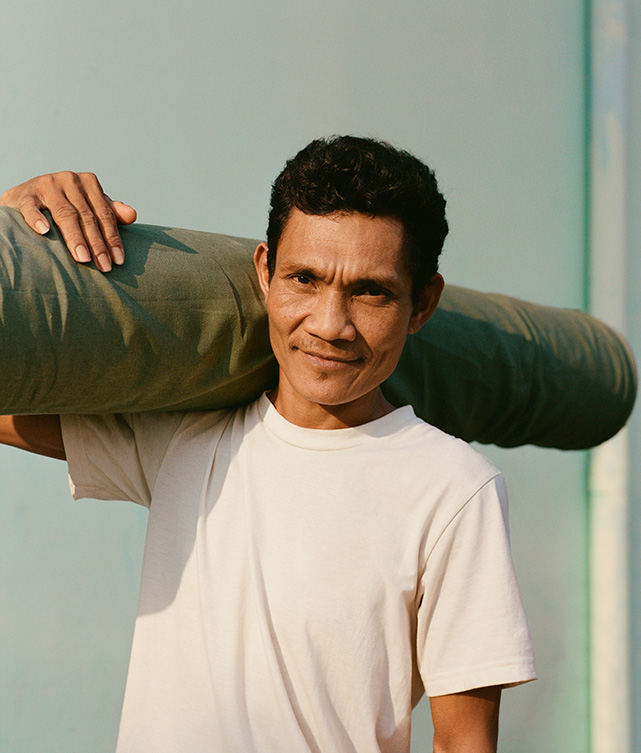
2025 / 100% lower-impact linen and polyester
2025 / 2Reducing our water consumption in our supply chain by 25%
2025 / Reaching three million people in our supply chain with our Workers in the Centre strategy
2030 / Protecting, restoring, regenerating or otherwise improving biodiversity across 5 million hectares
2030 / Reducing our emissions by over 50% (own operations and our value chain).
2030 / Using lower-impact textile fibres only (next gen fibres, recycled fibres and fibres obtained from organic or regenerative farming practices)
2040 / Achieving zero net emissions by reducing our carbon footprint by at least 90% by comparison with 2018

Circularity starts with design. That is why all our designers receive sustainability training. They are always open to new ideas and constant experimentation, the embodiment of the innovative thinking that characterises us. We pay special attention to the impact of the raw materials we include in our products, such as cotton, the fibre most widely used in our garments. To that end, we work with our suppliers to prioritise the use of cotton sourced from producers selected for their social and environmental performance, as certified by an independent third party, so enabling traceability.
Prioritising the use of innovative, recycled or organically and regeneratively farmed raw materials is key to transforming our industry, lowering greenhouse gas emissions and making responsible use of water and energy.
Creativity and disruption by design are essential aspects of our Sustainability Innovation Hub, the platform we use to search for better materials and processes, teaming up with startups and forging strategic research alliances with leaders from the chemicals industry, innovation accelerators and benchmark partners.
Through that platform we are working to scale up new types of recycled fibres through offtake commitments, such as Infinna™, a recycled fibre made from cotton-rich textile waste, and cycora®, recycled polyester made from textile waste. We are also making direct investments in startups:
/ CIRC, which has developed ground-breaking technology that will enable industrial-scale recycling of textiles made from poly-cotton blends, one of the biggest challenges facing our industry.
/ Infinited Fiber, a startup specialised in recycling cellulose fibres.
/ Galy, which has devised innovative technology for growing cotton in a lab using cotton plant stem cells.
/ Epoch Biodesign, which uses artificial intelligence to identify enzymes that enable the recycling of mixed plastics and textiles.
These advances are behind our pledge that by 2030, 100% of our textile products will only use materials that deliver a lower impact on the environment. In 2024, 73% of the textile fibres used in our products were lower impact, reaching a 39% of recycled fibres.